Disclaimer: This article is based on actual news from the real world – honestly! However, it has been sprinkled with a healthy dose of satire.
MIAMI — The National Weather Service confirmed that plummeting temperatures will cause green iguanas to lose consciousness and fall from trees, marking the third consecutive year the agency has been forced to warn Florida residents that iguanas seize up when it gets cold.
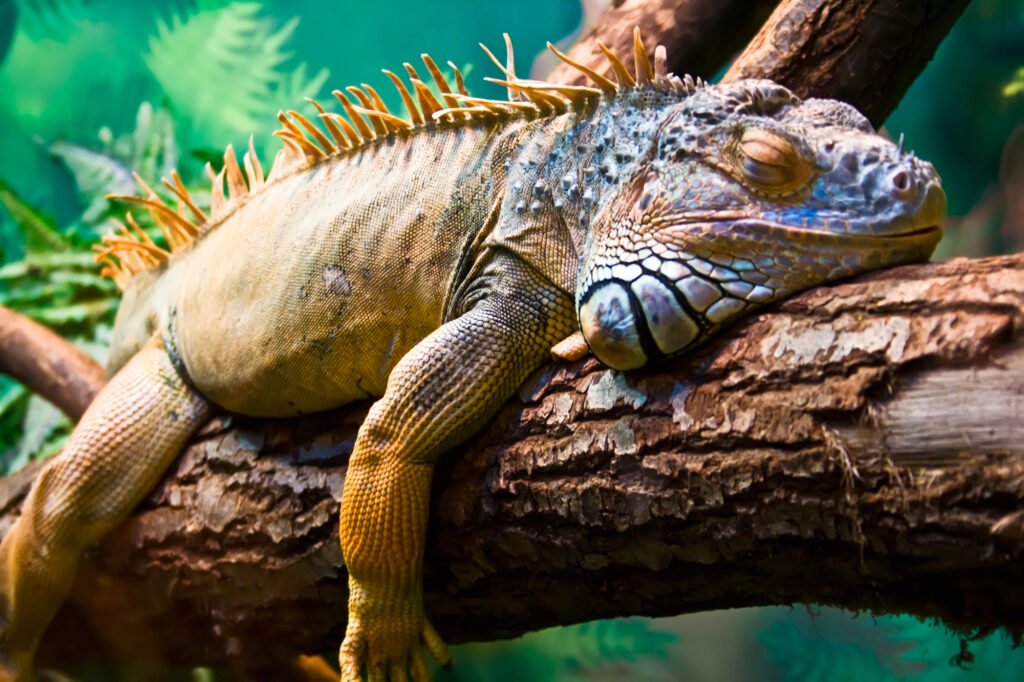
An iguana in a pre-falling-from-tree moment. (https://www.youtube.com/shorts/HFomo-RvvEw/depositphotos)
Iguanas, which sleep in trees at night to avoid ground-level predators, depend entirely on environmental heat to regulate their body temperature. The coming cold snap will render them functionally immobile until conditions improve, leaving them scattered across sidewalks, pool decks, and the hoods of recently waxed vehicles throughout South Florida.
The National Weather Service’s technical bulletin describes Tuesday’s cold front in measured terms: temperatures in the low 40s, wind chill in the 30s, duration approximately 12 hours. The bulletin does not describe what happens when several thousand invasive reptiles simultaneously lose motor function while twenty feet up in trees, because the Weather Service assumes you can do that math yourself. They fall, as all hubris eventually does, and lie there until the sun forgives them.
Ron Magill of Zoo Miami has been explaining iguana cold-shock for years with the patience of a man who knows nobody’s listening. “Their metabolism slows to near-zero below 45 degrees,” he said Monday, gesturing at a diagram he’s shown reporters at least six times this decade. “They lose grip strength. They fall. They’re not dead. They’re just waiting.” Waiting, presumably, for revenge.
“Then the sun comes out and they remember they have enemies,” he said. “That’s when it gets interesting.”
Officials recommend maintaining a safe distance from stunned iguanas, which they define as “farther than you think you need to be.” Residents are advised not to touch, move, photograph for social media, or attempt to warm the iguanas themselves, because while the reptiles appear deceased, they are in fact merely paused. The reptiles, though temporarily immobile, retain the capacity for aggressive response if disturbed. They have claws. They have teeth. They have tails capable of delivering strikes that witnesses describe as surprisingly personal.

On warming up on waking up, you have a grumpy iguana on your hands. (gonzalocallefotografia/depositphotos)
The cautionary tale officials reference occurred in 2018 on Key Biscayne, though “cautionary” implies people learn from it, and this is Florida we’re talking about. A man encountered frozen iguanas on the road. In his native Central America, iguana is a delicacy. In front of him were roughly a dozen free iguanas. The math appeared to work. He loaded them into his vehicle, started driving, and turned on the heat because it was cold outside. The next three minutes unfolded with the inevitability of Greek tragedy, if Greek tragedy involved reptiles and a 2004 Honda Accord.
He made it roughly three miles before the car’s heater kicked off an unfortunate chain reaction. By that point, the iguanas had warmed and regained consciousness, mobility, and what witnesses described as “profound dissatisfaction with current circumstances.” The vehicle swerved across two lanes before striking a median. Police arrived to find the driver extracting himself from the car while approximately a dozen iguanas also extracted themselves from the car. The driver sustained minor injuries. The iguanas, according to police reports, scattered into nearby vegetation and did not issue a statement.
Magill has simplified his advice over the years to a single imperative: “Leave them alone.” He no longer explains why. He no longer provides context. He has learned that people will either heed the warning or provide him with content for next year’s press conference. “If they recover, they recover,” he said with the resignation of a man who has watched people do everything except listen. “If they don’t, they don’t. If you pick them up, you’ll regret it.”
He added that frozen iguanas are capable of biting, scratching, and tail-whipping even in their stunned state, particularly if handled. “People see them lying there and think ‘free iguana,'” Magill said. “There is no such thing as a free iguana. You will pay dearly. They will make sure of it. I am so tired of having to say this every damn year.”
Florida Fish and Wildlife Commission officials noted that while the cold snap may seem cruel, it serves a regulatory function. Green iguanas, native to Central and South America, have established themselves as an invasive species across South Florida, where they damage infrastructure, consume native vegetation, and leave droppings in decorative fountains. Much like Florida Man, come to think of it.
The species has thrived in Florida’s typically warm climate, reproducing prolifically and outcompeting native wildlife. Periodic cold snaps represent one of the few natural population controls available.
“These cold snaps are the only thing that keeps the population in check,” explained Magill, who spoke with the enthusiasm of someone describing chemotherapy. “It’s not pretty, but it works.”
By Tuesday afternoon, temperatures are expected to climb back into the 60s, at which point the iguanas will resume functioning normally and return to their trees. Residents are advised to maintain situational awareness during the thawing period, as the reptiles tend to wake up confused and irritable, like Grandpa on a weekday morning after a bender.
Officials urge caution through Wednesday morning, though caution has never been Florida’s strong suit. Park vehicles inside if possible. Stay clear of trees. Don’t touch the iguanas, don’t help the iguanas, don’t harvest the iguanas, don’t question why this needs to be stated explicitly. The iguanas will thaw. They will return to their trees and their lives and their invasive-species activities. The iguanas will remain. Nothing will be learned. The circle of Florida life continues, as reliable as the weather that triggers it.
This story is based on fully factual news, but if we got it wrong, blame these guys, we’re just here to make it funny.