Disclaimer: This article is based on actual news from the real world – honestly! However, it has been sprinkled with a healthy dose of satire.
Researchers at UC Berkeley confirmed wild chimps consume the equivalent of two standard drinks per day from fermented fruit, making them the most consistent drinkers in any study not involving undergraduates. Aleksey Maro, a graduate student in integrative biology, spent three field seasons collecting fruit samples in African forests while chimps watched from trees, presumably wondering why the human kept sniffing their food.

Starting them young, like a responsible chimp! (Alain Houle/wikimedia)
The study examined 21 fruit species across research sites in Uganda and the Ivory Coast, where Maro collected freshly fallen fruits beneath trees where chimps had been eating. The fruits averaged 0.26% alcohol by weight, which Maro described as “a substantial dosage” using the kind of careful phrasing that suggests he’s been to some parties. Chimps eat roughly 10 pounds of fruit daily, meaning their alcohol intake adjusts to nearly two drinks when accounting for their 88-pound body mass versus the average 150-pound human, who definitely doesn’t need that comparison pointed out.
Professor Robert Dudley, who has built an entire academic career around his 2014 book The Drunken Monkey: Why We Drink and Abuse Alcohol, insists the findings support his hypothesis that human attraction to booze stems from primate evolutionary history. His theory initially faced resistance from primatologists who apparently hadn’t been to the same conferences and/or parties. Dudley noted that if chimps prefer riper, more sugar-rich fruits, the alcohol measurements indicate they might be drinking more than us.
The chimps feed throughout the day and show no visible signs of intoxication, mainly because feeling drunk would require eating so much fruit that their stomachs would become painfully distended. Maro confirmed the animals consume alcohol at levels similar to “what we might if we ate fermented food daily,” a dietary comparison that raises questions about exactly what Maro considers “daily fermented food consumption.” The steady ethanol intake suggests the last common ancestor of humans and chimpanzees encountered alcohol every day, a revelation that will surprise no one of Irish heritage.
Field observations included male chimps gathering in fig tree canopies before heading out on territorial patrols, behavior Dudley declined to compare to tailgating, but it was right there, man, come on. The most alcohol-rich fruits at each site were also the most frequently consumed, though researchers remain uncertain whether chimps deliberately seek higher ethanol content or just prefer riper fruit that happens to be fermented. The distinction matters enormously to primatologists but not at all to the chimps themselves.
Dudley’s research has expanded to show that alcohol consumption isn’t limited to primates. Earlier studies found alcohol metabolites in bird feathers from 10 of 17 species tested, indicating their diet of nectar, grain, and insects contained significant ethanol. One hypothesis suggests animals seek ethanol because its smell helps locate sugar-rich foods that provide more energy. Another theory proposes that alcohol makes eating more rewarding, “in a way that resembles sipping wine with a meal,” according to Dudley, who appears unfamiliar with gas station wine.
The most alcohol-rich fruit species, Ficus musuco at Ngogo and Parinari excelsa at Taï, are also favorites of elephants, animals known for being drawn to alcohol and never forgetting where they left their keys.
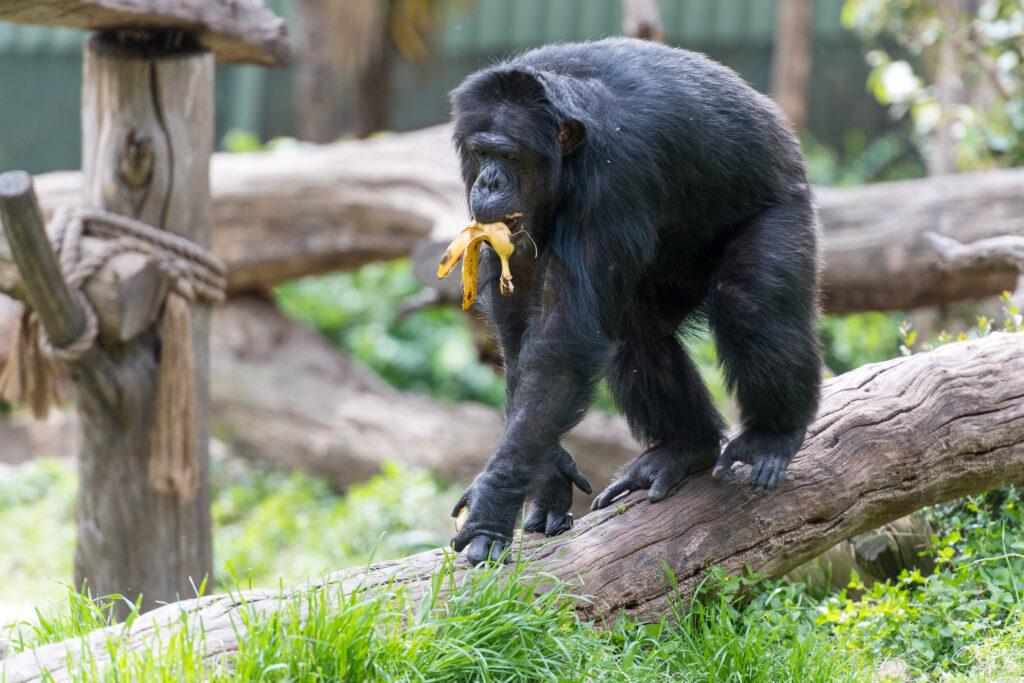
That's a chimp that's had one too many banana daiquiris. (Eric Kilby/flickr)
During a follow-up field season, Maro collected urine from chimps while they slept in trees, a task requiring an umbrella and what he described as “patience.” He tested samples for alcohol metabolites using kits similar to those employed in U.S. workplaces, though chimps have yet to fail a drug test or be required to attend mandatory HR presentations. Team member Laura Clifton Byrne, an undergraduate at San Francisco State, shadowed foraging chimps and retrieved freshly dislodged fruits from beneath the canopy for immediate alcohol testing, a research method that sounds a lot like following monkeys and picking up what they drop.
The professor noted findings “point to the need for additional federal funding for research into alcohol attraction and abuse,” citing alcohol’s “deep evolutionary background,” a phrase that suggests either profound scientific importance or that he’d really, really like to keep studying drunk monkeys. The request for more funding was submitted alongside the peer-reviewed paper, published in Science Advances, which confirmed that chimps drink responsibly and humans do not. The study establishes baseline data for future research, determining whether chimps deliberately select fermented fruit, a question that will apparently require multiple grant cycles and several more years of umbrella-assisted urine collection to resolve.
This story is based on fully factual news, but if we got it wrong, blame these guys, we’re just here to make it funny.