Disclaimer: This article is based on actual news from the real world – honestly! However, it has been sprinkled with a healthy dose of satire.
On April 26, 1986, the Chernobyl Nuclear Reactor in northern Ukraine, then part of the Soviet Union, exploded in a catastrophic meltdown that stands to this day (fingers crossed) as the greatest nuclear disaster the world has ever seen.

Two original Chernobyl Dogs, Barney (foreground) and Gus (background) search for food at cooling towers. It has been nearly 40 years since they witnessed what they call "the big poof". (Norman Kleiman/PHYS.org)
The 2,600 square kilometers of land surrounding Chernobyl is uninhabitable for humans and will remain that way for the next 20,000 years. Though now a desolate wasteland devoid of human life, various plant, fungal, and animal species have survived. Wolves, bears, and even little tree frogs have thrived on their own. Scientists are now taking a closer look and investigating how decades of radiation exposure may have altered animals’ genomes, and even, possibly, sped up evolution.
To learn for myself, I sat down with a representative of the Chernobyl Canine Coalition (CCC), Barney. Barney was just a puppy 40 years ago when the Chernobyl Nuclear Power Plant suffered its horrific meltdown. Barney was orphaned by a young family of three who disappeared in what the animals of Chernobyl refer to as “the big poof”. Barney foraged for food and faced off against all manner of antagonistic, marauding carnivores, until finally joining forces with Gus, another young pup left alone and glowing amongst the cooling tower ruins.
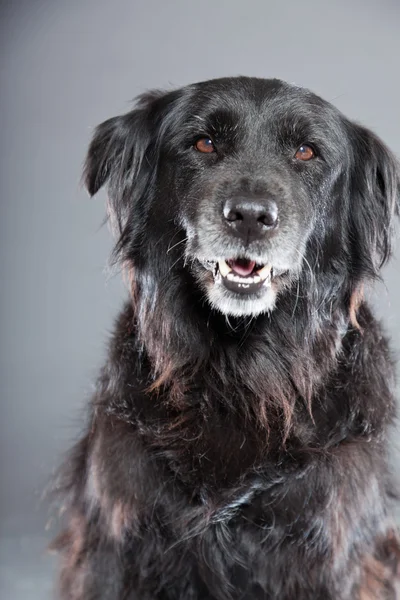
At forty years of age, Barney is one of the few remaining survivors of the Chernobyl Nuclear Power Plant Meltdown of 1986. (YS Brand/depositphotos)
“I’ve outlived dogs half my age,” says Barney proudly. His fur is dark, not quite black, but you can tell that it once was. As he sits looking at me, he’s smiling proudly at his Yogi Berra-esque witticism. There was once a sparkle in those brown eyes, I can see it in there, it comes standard with all dogs. But the decades have worn circles around his eyes, and although he does his best to appear lighthearted, there is a weight that hangs over his front haunches.
Barney recalled the first months as the hardest times. “At first, there was nobody around to play with. No one to throw a stick to me, or to pour kibble into my bowl. That took some getting used to.”
Although only ten months old at the time, Barney was energetic and feisty, but he was not yet as strong as he would one day be. He was forced to survive on his wits and instinct. “I remember one day I thought it would be a good idea to help myself to a refreshing drink out of the local pond that won’t stop bubbling. I got into some trouble with a gray wolf who thought it would be a good idea to eat me for his dinner.”
“That’s when I jumped in!” interrupted Gus.

Gus the dog. He's part German Shepard, part radiation, and all survivor. (Anton_Moroz/depositphotos)
The ensuing scuffle and banishment of said wolf began what would become a lifelong friendship and partnership. Gus and Barney began what is now known as the CCC in the early 1990s and have helped support and maintain the local Chernobyl canine community.
“There is no such thing as a stray dog here in Chernobyl,” says Barney. “We realized back then that the only way we could get through these tough times was together.”
“It was essential to have a community to fall back on. There was always someone to talk to, someone who was going through the same things as you are,” says Gus. “Being exposed to massive doses of constant radiation can be scary sometimes.”
“Right,” added Barney. “I remember how scared I was the day I woke up and realized that I could speak.”
“No,” Gus corrected his friend. “The day we developed the ability to speak wasn’t scary, it was exhilarating.”
To which Barney replied, “That day was scary for me because that’s also the day my tail fell off.”

The tree frog, once green, has mutated due to radiation from the Chernobyl nuclear disaster. Locals consider blackened tree frog a delicacy. (istock )
“Things fall off, things grow on, every day is a new adventure.” Barney chuckled as he struck a match. “Growing opposable thumbs, who knew what a game changer that would be,” he opined.
Barney lit a cigarette, he inhaled deeply, and exhaled a plume of gray that instantly disappeared into the colorless landscape behind him. “Cigarettes, these babies, let me tell you. If there is one thing, this place is lousy with its cigarettes. Who would have thought that Ukrainian plutonium technicians in 1986 would have been such heavy smokers?”
When asked if he feared smoking tobacco would take years off of his life, Barney became suddenly distant, his demeanor shifted from jovial to melancholic. His stare shifted towards the horizon as if a tennis ball had just been tossed a mile away.
“There were fewer than 350 of us at the beginning,” Barney spoke reverently. “Times have not been easy, but we have survived. Thirty generations of dogs have come and gone since the big poof. There are still twenty-five of the original pack alive. Our oldest member is fifty. I don’t know if I will ever die. I don’t know if that big poof was a blessing or a curse.”
“But there were good times too.” Gus cut in, sensing that the mood had gone somber as is the custom in Siberia.
“Chernobyl is not all bad.” Barney conceded. “Sure, there are no people around, but most think that is a pretty good thing. We don’t know why the big poof took the people away, but I have a feeling the whole thing may have been their fault to begin with.”
“And the food!” Gus, salivating now, besieged his friend. “Tell them about the food!”
“Do you like squirrel? I was eating a squirrel.” Barney began. “You can’t get squirrel like back in the day anymore. Those first few months after the big poof, you’d chase down a squirrel and bite into him, and I swear to god, it was like he just came out of the microwave.”
“One day, for no apparent reason, all of the little green frogs turned black.” Gus brought up the very genetic mutation in tree frogs that had captivated scientists when discovered in 2016. His respect was more to the epicurean nature of it all. “You have not lived until you have eaten a bucket or two of blackened tree frog!”
Assuredly, for scores of generations to come, scientists will be studying the manmade disaster that was Chernobyl. The most fascinating aspect will continue to be the genetic anomalies and effects on the remaining animal population.
When asked if he anticipated the CCC would continue to cooperate with the scientific community, Barney’s reply was immediate, suddenly stoic, and unambiguous. “As long as you people keep air-dropping those cigarettes,” he grinned, “the Chernobyl Dogs will always be man’s best friend.”