


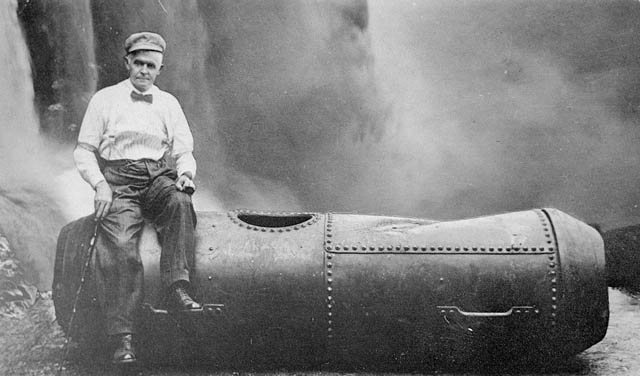
There has to be an easier way to make a buck: Bobby Leach and the steel capsule both got pretty dinged up when going over Niagara Falls. (Library and Archives Canada/Wikimedia Commons)
Disclaimer: While this article is cascading with historical facts, please be careful not to slip on the satire discarded on the ground.
On April 28, 1926, stuntman Bobby Leach died from an injury, which generally wouldn’t be strange in his profession, except that the injury occurred while he was simply walking. It came at the hands of citrus, specifically an orange peel, rather than from one of his Niagara Falls stunts or during his time working for the Barnum & Bailey Circus.
Despite the unfortunate accident, Leach actually led a fairly long life for his profession, being 69 years old when he died. He was born in Manchester, England, then moved to the United States at age 18. He would eventually join Barnum & Bailey as a stuntman, using his aquatic skills to perform high dives and swimming tricks. People back then needed entertainment too, something to console them from the sad thought that the microwave wouldn’t be invented for several more decades. How did people live?
His best-remembered stunt is going over Niagara Falls in a barrel, which is something that people used to do occasionally. Leach actually rode the Falls in a steel capsule in 1911 at age 53 and survived to tell the tale. And he went on to tell the tale many times in a traveling show, though first he spent six months in a hospital recovering from injuries that included two broken kneecaps and a fractured jaw. Just after the stunt would have been a good time for a jokester to say, “Sorry, Mr. Leach, the cameras jammed; any chance you can do it again?” Unfortunately, there is no report of someone having said that.
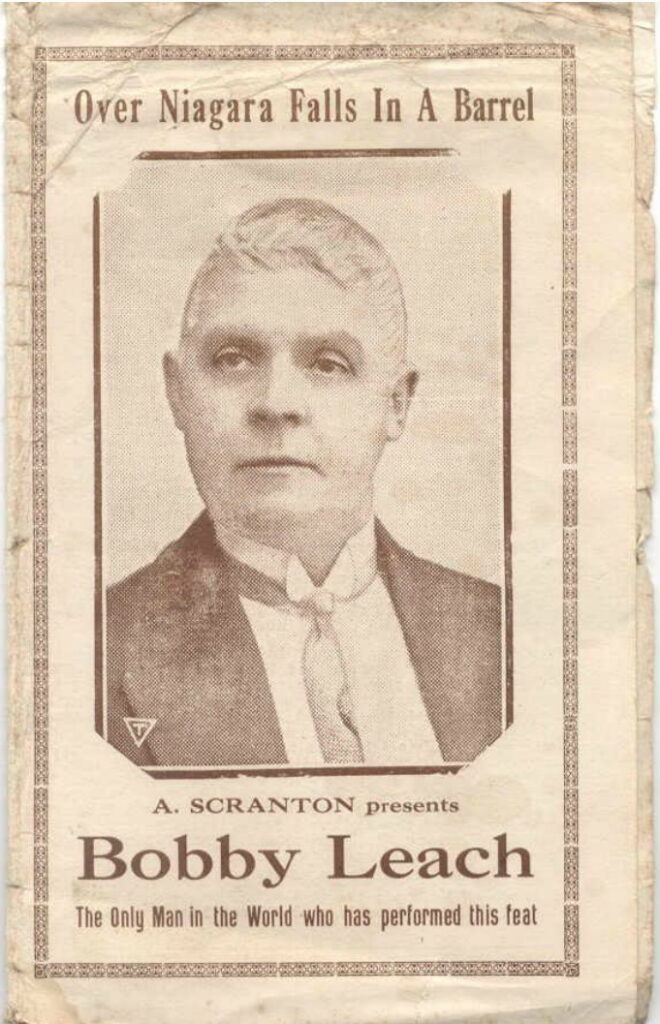
A Bobby Leach poster, circa 1911. While he was technically "the only man" to have gone over Niagara Falls, a woman had done it first, so he was the second person. But hey, when you're promoting, you do what you have to do. (Public Domain Image/Wikimedia Commons)
Leach was the second person to successfully go over Niagara Falls, after Annie Taylor, a teacher, did it on her 63rd birthday in 1901. “Anything to get away from those lousy kids in school for a while,” she might have said before hurling herself over the Falls for the bumpiest ride of her (or anyone else’s) life.
Bobby Leach was awarded a medal after his Niagara Falls feat. The medal was dated 1911 and included an engraved image of a person going down the Falls. The back of the medal read “Presented by the citizens of Niagara Falls, Canada, for pluck & grit.” A large cash prize might have been nice, but hey, a medal is pretty cool too.
“It makes me sad that he isn’t alive today. I mean, just think of all the YouTube views and likes on social media! Man, what could have been.”
– A guy outside a Dairy Queen after being told who Bobby Leach was.
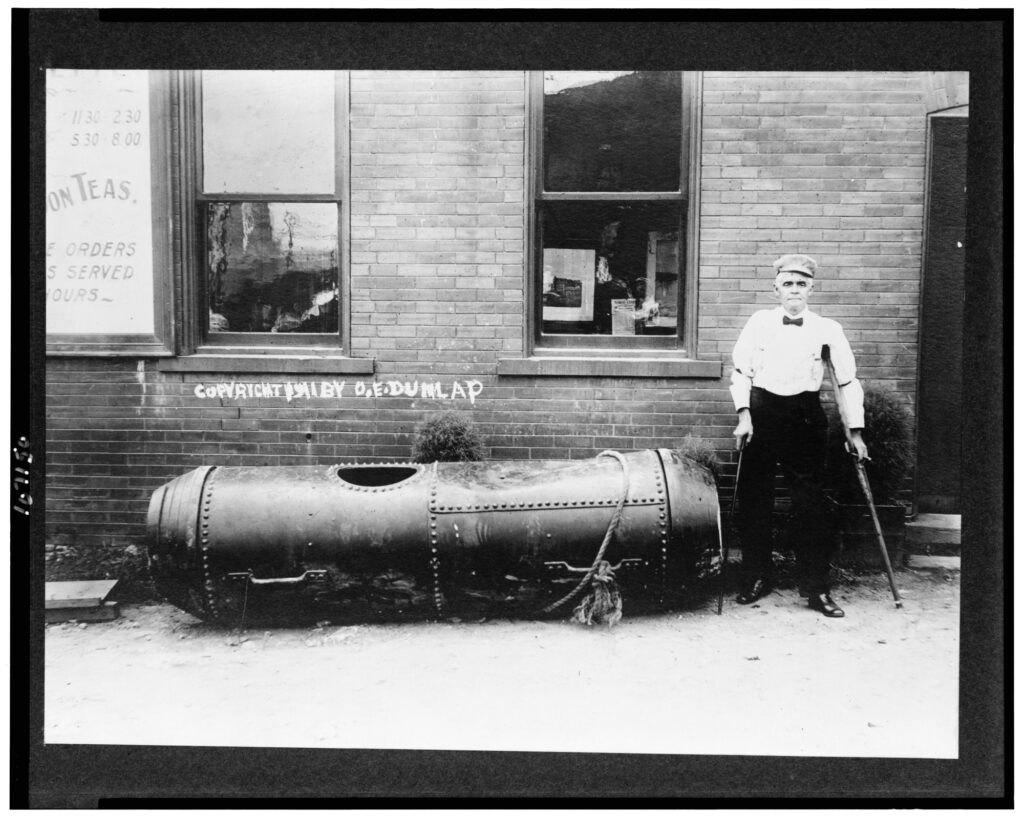
Bobby Leach and his barrel, 1911. Few people know the feeling of falling over Niagara Falls in a tube, and there's a reason for that: it's kind of a nutty thing to do. (O.E. Dunlap/Wikimedia Commons)
Leach would return to Niagara Falls years later, at age 60, for another stunt: he tried to swim the whirlpool of the Falls, but after several unsuccessful attempts, he had to be rescued. Like most sequels, it didn’t work out well, but at least he survived the stunt, so that’s good.
Leach traveled the world telling stories about his successful 1911 heroics at Niagara Falls. He was accompanied by the steel barrel, which had a window in it because it’s nice to have a good view while you’re voluntarily plummeting to your likely death. He did many traveling shows, since these were the days before streaming video when people had to actually leave their homes and be among other people in order to get entertained – dark days indeed.
After one show in New Zealand, Leach slipped on an orange peel while walking and broke his leg. He had been doing shows in New Zealand for several months, and his wife and daughter had joined him on the tour. Leach would get gangrene from the injury, the leg was amputated, and two months after the fall, on April 28, 1926, he died. “Years from now, I hope snarky people don’t just remember me for slipping on a peel,” Leach might have said, but probably didn’t. “Oh well, it’s been a good life, though admittedly a bit strange here and there.”
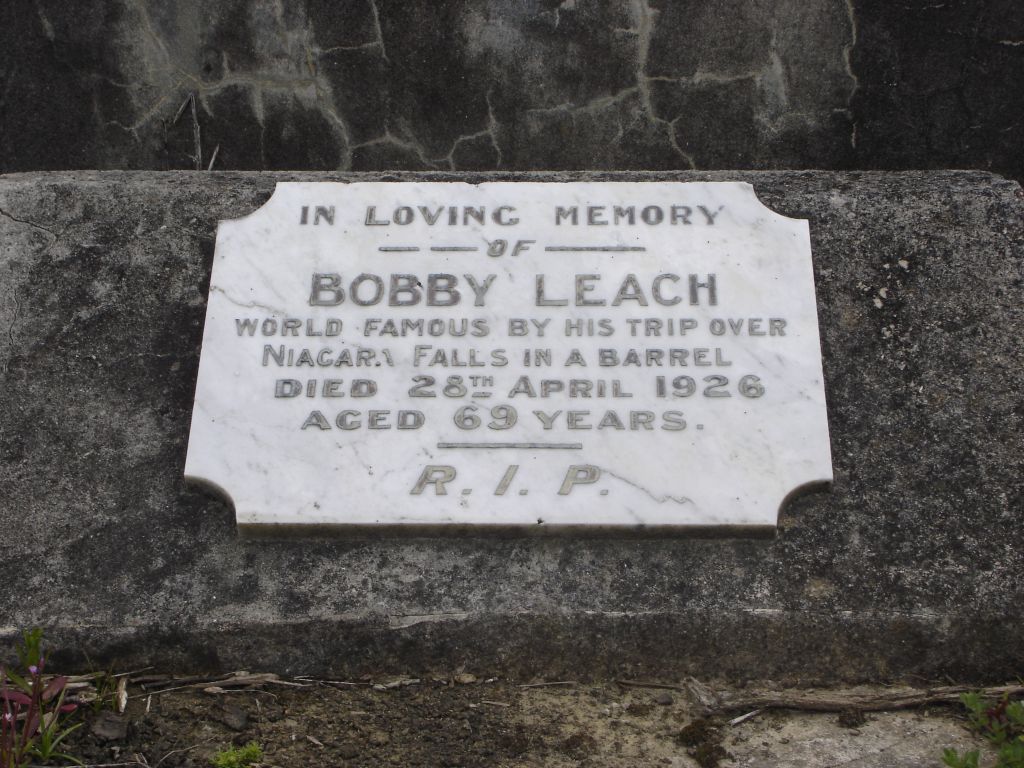
Bobby Leach's grave in Auckland, New Zealand. (Sarndra/Wikimedia Commons)
Bobby Leach was buried in Hillsborough Cemetery, in Auckland, New Zealand. An odd end to an eventful life.




