Disclaimer: This article is based on actual news from the real world – honestly! However, it has been sprinkled with a healthy dose of satire.
A delicate Australian shrub last documented during the Summer of Love has been confirmed alive in remote Queensland after a horticulturalist named Aaron Bean photographed it on a cattle station and uploaded the image to iNaturalist, where it was identified by a botanist named Anthony Bean. The two Beans are not related, a detail researchers offered without anyone asking. They are also not related to the more famous Mr. Bean, in case anyone was wondering.

Nah, not this one. (Antonio Zugaldia/wikimedia)
Aaron Bean was on the property to band birds when he wandered past the bush. He took photos of several plants that struck him as interesting, then drove until he had reception on his phone. Anthony Bean, a Queensland Herbarium botanist, identified the species within minutes. He had formally described Ptilotus senarius himself ten years earlier, and had spent the decade since describing a plant nobody had seen since Lyndon Johnson was president.
Ptilotus senarius grows near the Gulf of Carpentaria, a region so remote that roughly one-third of Australia is privately owned, and the rest is trying to kill you. The plant produces small purple-pink flowers that, per the journal description, resemble “small feathered fireworks,” a phrase that suggests the author had recently celebrated Guy Fawkes Day in the wrong hemisphere.
Researchers said the rediscovery hinged on the property owner granting access, the bird-bander noticing an unfamiliar shrub, and the herbarium happening to employ the one man on Earth who could identify it. Thomas Mesaglio of UNSW called the convergence “very serendipitous,” which is botany-speak for “we got extraordinarily lucky and would prefer not to discuss what that implies about the other 899 plants currently presumed gone.”
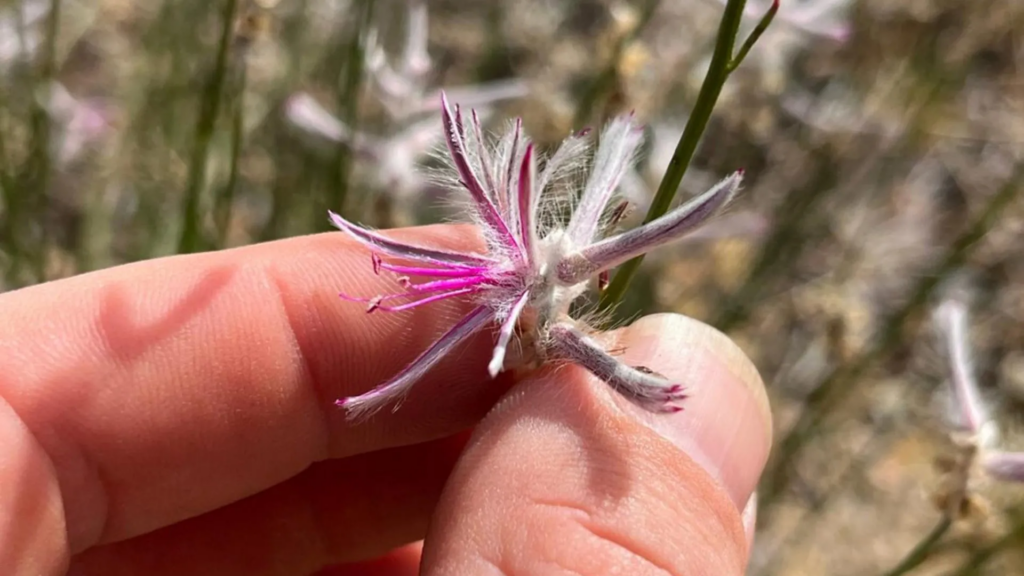
(Aaron Bean/inaturalist.org)
The species has been formally promoted from extinct to critically endangered, a category sometimes summarized as “alive, but please stop everything you are doing.” Ptilotus senarius has now lived through six decades of obscurity, one published paper describing it as deceased, and the rediscovery of itself, and is expected to spend the remainder of its existence being photographed by strangers it did not ask to meet.