


Disclaimer: This article is based on actual news from the real world – honestly! However, it has been sprinkled with a healthy dose of satire.
Marine biologists are locked in what observers describe as “an academic slap fight” over whether sperm whales communicate using vowel-like patterns or whether researchers just need better microphones. The disagreement was published in Open Mind, where it will presumably stay until someone figures out how to ask a whale directly, and centers on whether the difference between whale “clicks” and whale “clacks” represents sophisticated language or regular old AI model collapse.
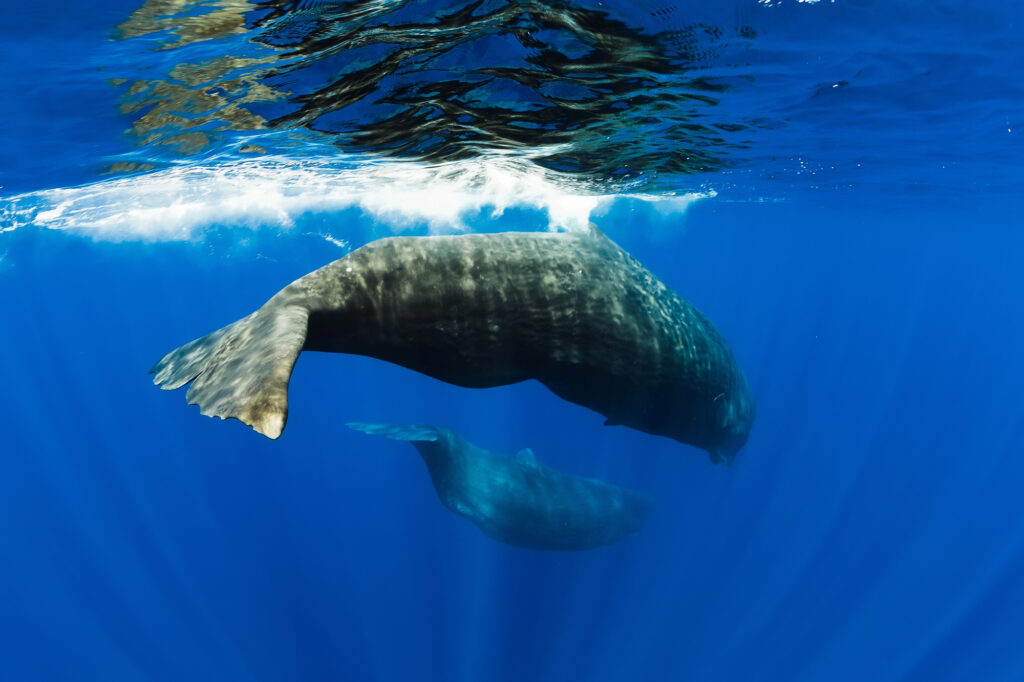
A couple of whales, clicking and clacking and confusing scientists. (Keola/depositphotos)
Project CETI, a Dominica-based nonprofit, claims artificial intelligence detected previously unknown acoustic patterns in sperm whale codas, the rhythmic click sequences whales use to identify their social groups. Linguist Gašper Beguš says the discovery suggests whales might use these sounds “in a similar way as we use our vowels to transmit meaning.” The discovery suggests sperm whales structure their clicks the way we structure our vowels, which would be revolutionary, especially if any whales confirmed this personally.
Enter Luke Rendell, who has dedicated three decades to understanding sperm whale communication and would like everyone to calm down. Rendell calls the vowel comparison “completely nonsense.” He suggests the researchers are hearing ripples in their recordings rather than revolutionary cetacean grammar, ripples that apparently whisper sweet linguistic nothings to eavesdropping AI systems. “There’s no evidence that the animals are responding in any way to this new pattern,” Rendell says, in a tone that can only be described as “professionally exhausted.”
Beguš insists his team was careful. Very careful. So careful, in fact, that they found the same patterns in whale recordings from other labs using completely different equipment. This compelling evidence has not been published yet, but definitely exists and definitely proves everything. Rendell’s facial expression upon hearing this could not be transcribed without violating journal decorum standards.
The research relies on a generative adversarial network, an AI system that learned to recognize real whale codas while possibly also learning to invent fake ones convincing enough to fool itself. To analyze frequencies, Beguš removed the spaces between clicks in recordings so they ran together, allowing human ears to detect subtle differences.
Marine biologist Denise Herzing calls this technique “interesting” in the way academics describe ideas they’re not permitted to mock yet. Herzing, who has studied dolphin communication for over 40 years, objects strenuously to the word “vowel.” She warns that unfounded claims about dolphin intelligence in the 1960s and ’70s killed communication research in her field for decades. “People who read that might jump to the conclusion that the animals are using something like human language,” she says, describing a conclusion the paper’s authors appear to have jumped to first.

A majestic AEIOU whale. (Keola/depositphotos)
Stephanie King, a marine biologist at the University of Bristol, suggests the acoustic patterns might simply indicate whale arousal levels rather than linguistic meaning. Similar patterns across the animal kingdom correlate with alertness, she notes, raising the possibility that researchers have spent years analyzing the difference between “awake whale” and “very awake whale.” This raises the methodological concern that Project CETI has been conducting a multi-year study of whale caffeine consumption rather than whale linguistics.
Project CETI’s Shane Gero acknowledges the pattern might “encode for emotional state,” but insists it’s worth exploring other possibilities. His team is currently gathering data on whale locations and activities during different types of codas, a process expected to determine whether the animals are speaking in vowels or just clicking enthusiastically near interesting fish.
The debate continues as marine biology is fractured into two camps: those who believe sperm whales have developed a sophisticated sound system rivaling human language, and those who believe sperm whales have developed a sophisticated ability to make scientists argue with each other. Whales have not clarified which interpretation they prefer, continuing to emit clicks at frequencies that may convey profound meaning or may simply indicate they’re paying attention.
The scientific community awaits publication of the cross-laboratory verification data. Meanwhile, researchers have requested that journalists stop using phrases like “whale vowels,” “cetacean grammar,” and “aquatic linguistics” in headlines, a request this headline thoroughly ignored.
This story is based on fully factual news, but if we got it wrong, blame these guys, we’re just here to make it funny.




