


Disclaimer: This article is based on actual news from the real world – honestly! However, it has been sprinkled with a healthy dose of satire.
When an oil spill spreads across the ocean, emergency crews traditionally face two unpleasant options: leave the crude oil floating toward beaches and wildlife habitats, or set the ocean on fire. Researchers now believe there may be a third option: set the ocean on fire, but also make a tornado at the same time.
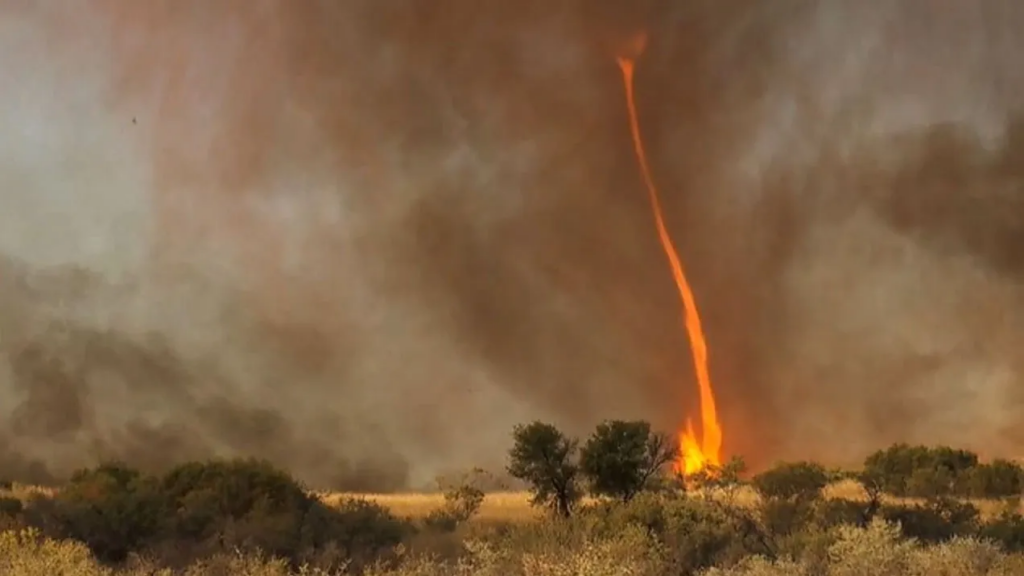
Just your average firenado. (stilltalkincrazy/Youtube)
Scientists from Texas A&M and UC Berkeley have successfully demonstrated large-scale “fire whirls,” towering spinning columns of flame that resemble miniature fire tornadoes and burn spilled oil faster and more efficiently than conventional methods. The findings suggest future cleanup crews may be able to combat environmental disasters using a sentence that previously existed only in Michael Bay scripts.
The rotating flames draw oxygen into the vortex’s center, creating hotter, cleaner combustion. Researchers found the fire whirls consumed oil substantially faster while producing less soot and smoke. This represents a rare scientific achievement in which adding a tornado to anything somehow improves the outcome.
Officials say the work was inspired by the challenge of responding to catastrophic spills such as the Deepwater Horizon spill. Apparently, they could have just burned the whole thing down with a fire tornado.
To test the concept, engineers constructed a sixteen-foot structure around a pool of crude oil and ignited it at a Texas fire training facility. Witnesses described the resulting seventeen-foot vortex as both scientifically promising and an excellent reason to update many workplace safety forms.
The fire whirl burned oil roughly 40% faster, reduced soot emissions by 40%, and consumed up to 95% of available fuel. Researchers characterized the results as encouraging. Insurance companies characterized them as “concerning.”
It turns out, and who could have predicted this in advance, fire tornadoes remain difficult to control. Strong winds can destabilize the vortex, while slight changes in fuel conditions can cause the whirl to collapse. Researchers refer to the ideal operating conditions as a “Goldilocks zone,” a technical term meaning the fire tornado must be not too hot, not too cold, and not sleeping in anyone’s bed while they’re away. Perhaps I may have confused the metaphor.
Still, the team believes portable systems could someday generate fire whirls on demand above active spills. If successful, future cleanup operations may consist of helicopters, containment booms, emergency personnel, and one extremely nervous employee whose job title has become Director of Oceanic Fire Tornadoes.
The next phase of research will focus on scaling the technology for real-world deployment. Pending successful trials, humanity may soon be able to tell future generations that it saved the oceans by carefully unleashing giant spinning columns of fire, and somehow this will make sense.




