


Disclaimer: This article is based on actual news from the real world – honestly! However, it has been sprinkled with a healthy dose of satire.
CAMBRIDGE, Mass. — The countdown to December 19 has begun, when interstellar object 3I/ATLAS will pass Earth at a distance that Harvard’s “honorary village idiot” Avi Loeb calls “suspiciously convenient for avoiding detection” and NASA calls “exactly what you’d expect from a comet.” The space rock will be 269 million kilometers away, close enough to generate headlines, far enough to avoid disproving anything, and the perfect distance for prolonged speculation and the slow death of empirical standards.
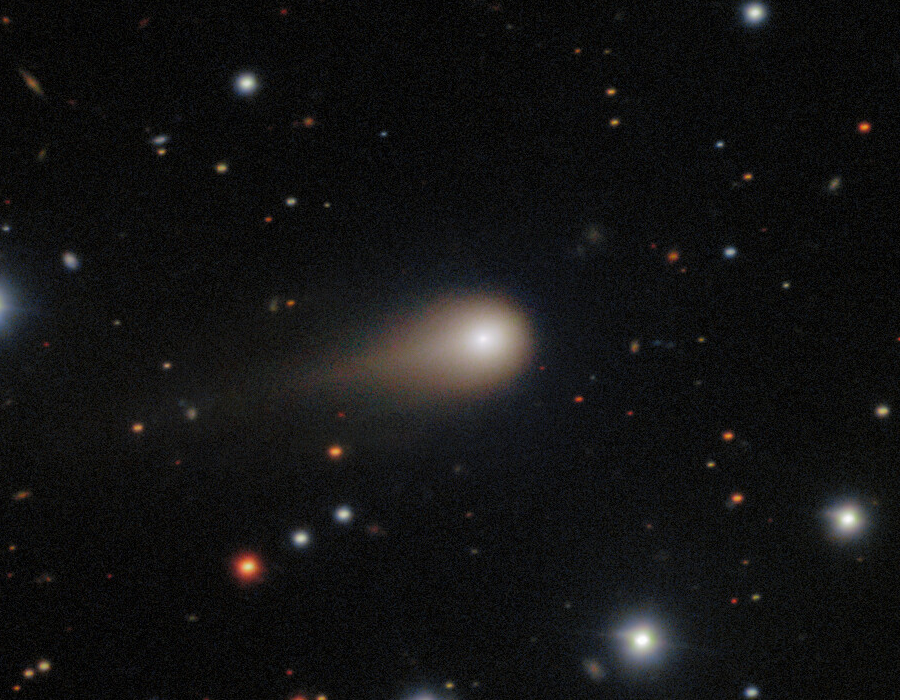
3I/ATLAS, a spaceship in a comet's clothing? (International Gemini Observatory/NOIRLab/NSF/AURA/Shadow the Scientist)
The object, which recently sprouted seven distinct jets while passing near the sun, has reignited Loeb’s well-documented campaign to convince humanity that literally everything in space is aliens. The jets are formations extending half a million kilometers in what astronomers call “typical cometary outgassing” and Loeb calls “exactly what I’d design if I were piloting an interstellar probe through hostile territory.” They appeared vigorously active, fully extended, and precisely positioned, exhibiting behavior Loeb describes as “unmistakably deliberate” and NASA describes as “Jesus Christ, Avi, they’re gas vents.”
“This multi-jet structure constitutes a remarkable target for future observations,” Loeb wrote on Medium, a platform he has turned into a kind of alien-spotting newsletter service. “The foundation of pioneering scientific research is the humility to learn rather than the arrogance of expertise,” he added, apparently without irony, before spending another 3,000 words whining, without evidence, that everyone else’s expertise is wrong because reasons.
The ‘Oumuamua incident of 2017 marked the beginning of what historians may someday call the Loeb Era, assuming historians exist who catalog the slow transformation of tenured professors into tabloid fixtures. The object’s passage divided Harvard’s astronomy faculty into camps: those who believe comets can be cigar-shaped without being manufactured by Klingons, and Avi Loeb. Faculty retention documents from that period note “philosophical differences regarding the nature of interstellar rocks” and “irreconcilable views on what constitutes peer review versus what constitutes a Joe Rogan appearance.”
Since then, Loeb has founded the Galileo Project at Harvard, written multiple bestselling books about aliens, appeared on Joe Rogan’s podcast, and led an expedition to retrieve, what he claimed were, fragments of an interstellar meteor from the Pacific Ocean floor. The Pacific expedition cost $1.5 million, retrieved 50 spherules from the ocean floor, and proved conclusively that the ocean floor contains spherules, which it always has, being an ocean floor. The fragments turned out to contain terrestrial contaminants, but Loeb maintained they could still be alien in origin, because that’s literally the only thing he ever does.
Dr. Richard Moissl, Head of Planetary Defence at the European Space Agency, arrived at a press conference with prepared remarks, three peer-reviewed studies, and the defeated expression of a man who knows he’s about to explain why comets spray gas for the millionth time this year. Moissi told reporters there have been “no signs pointing to non-natural origins” in any observations of the comet, then quietly added Loeb’s email address to his spam filter. He reiterated that the European Space Agency’s official position remains “it’s a comet,” refined over six months to the current formulation “it’s a comet, for f***’s sake.”

Avi Loeb, with what we're assuming is his shiny pet alien. (Christopher Michel/wikimedia)
According to Loeb’s calculations, 3I/ATLAS has several suspicious characteristics. Its trajectory has an orbital eccentricity of 6.137, which he notes is “extraordinarily high” and “consistent with targeting behavior,” though it’s also consistent with being a comet from outside our solar system, which is literally what NASA says it is. The object’s path brings it remarkably close to the ecliptic plane of Earth’s orbit, which Loeb calculates has only a 0.2 percent probability of occurring randomly, therefore proving aliens, or possibly proving that space is big and coincidences happen.
NASA’s counter-analysis, submitted as “Why We Don’t Respond to This Anymore: A Technical Review,” notes that low-probability events occur constantly in a universe containing approximately 10²⁴ stars, making coincidences statistically inevitable rather than statistically suspicious, a point Loeb dismisses as “closed-minded,” “dumb,” and that NASA is “a butt.”
Every comet can’t be aliens, every rock can’t be technology, every coincidence can’t be conspiracy, or eventually words stop meaning anything, and we’re all just shouting into the void, which maybe we are anyway, but at least most astronomers pretend otherwise.
The object will reach its minimum distance from Earth, approximately 167 million miles, on December 19, which Loeb describes as humanity’s potential “closest ever encounter with alien life and technology.” This distance is roughly 700 times farther than the moon, meaning the aliens are either playing hard to get or are actually just a comet made of ice and rock, but Loeb remains committed to the former interpretation. The aliens will observe us from 167 million miles away, allegedly, if they exist, which they might, according to Loeb, who would certainly not know, having never met one.
“It is unlikely that particle probes on Earth-based satellites will be able to capture particles from these jets,” Loeb explained, essentially confirming that the spaceship will be too far away to prove it’s a spaceship, but also that this fact somehow supports his spaceship theory. He noted that even NASA’s Juno spacecraft near Jupiter will be 33 million miles away during its March 2026 observation, “an order of magnitude larger than the extent of the current jet structure,” which in non-astronomer terms means “really quite far away and therefore unable to disprove anything I’m saying.”

Maybe the spaceship is named "Comet," and that's where the confusion lies. (magann/depositphotos)
Fellow physicists have grown weary of what they describe as Loeb’s “pattern of making extraordinary claims before collecting extraordinary evidence.” Theoretical physicist Michio Kaku recently warned against “leaping to conclusions” about alien origins, noting that 3I/ATLAS is simply “a very old object” that has had plenty of time to accumulate space debris, much like how Loeb has had plenty of time to accumulate media appearances and hard evidence, except he doesn’t have any of the latter.
“In 7 billion years, there’s been plenty of time to accumulate garbage,” Kaku said of the comet, though colleagues noted the statement could apply equally well to Loeb’s publication record over the past decade.
The scientific community largely agrees that 3I/ATLAS is a natural comet: an icy body releasing gas and dust as it approaches the sun, creating the observed jets through a process understood since at least the 19th century. Observations have confirmed the presence of water and other compounds typical of comets. But Loeb counters that water is exactly what aliens would use to disguise their spacecraft, if they were clever, which they obviously are, which is why we can’t detect them, which proves they exist. Not.
When asked about the criticism from peers, Loeb has repeatedly stated that science requires “humility to learn” and that his critics are simply uncomfortable with ideas that challenge their worldview, particularly ideas like “what if this regular ass comet is actually a spaceship.”
“Science demands we question assumptions,” he insists, questioning every assumption except his own, challenging every theory except his theories, demanding open-mindedness from everyone who disagrees with him, and displaying the unearned confidence of someone who thinks they know the answer before even seeing the question.
The comet will continue its journey through the solar system following its December flyby, eventually departing our cosmic neighborhood forever. Loeb plans to monitor it continuously, just in case the aliens decide to drop their cloaking shields and wave hello, or perhaps leave a Yelp review of Earth before heading back to wherever regular interstellar comets come from, assuming they’re not all spaceships, which Loeb has not yet ruled out because he is attention-whoring to sell books about space things he made up.
Harvard’s astronomy department declined to comment, citing a longstanding policy of pretending their faculty’s alien theories are happening at someone else’s university.
This story is based on fully factual news, but if we got it wrong, blame these guys, we’re just here to make it funny.




