


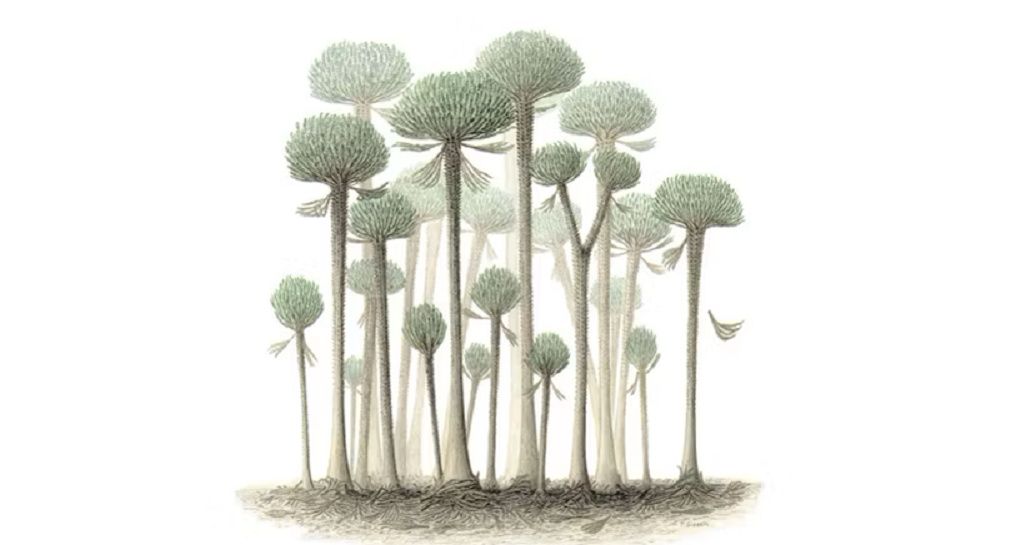
Reconstruction of a Calamophyton forest, trees drawn measure 9-12 bananas high, depending on how curvy the banana. (Peter Giesen & Chris Berry/Cardiff University)
A groundbreaking discovery, as researchers from the Universities of Cambridge and Cardiff have unveiled the world’s oldest known fossilized forest, dating back a staggering 390 million years. The find, located within the Eifelian Hangman Sandstone Formation along the Devon and Somerset coast of South West England, predates the previous record holder by four million years. Reached for comment, the previous oldest fossilized forest said, “I was petrified this would happen. Get it?”
Published in the Journal of the Geological Society, the study reveals that the fossilized forest belonged to the Devonian period, spanning from 419 to 359 million years ago, and named after the 80s band Devo. Professor Neil Davies, a paleontologist at the University of Cambridge, brought attention to the transformative impact of the Devonian period on the planet.

A) Impression of cladoxlylopsid trunk, (a great Scrabble word) B) Woody debris (not to be confused with Woody Allen) C) Drag mark (Ru Paul's Drag Race Season 3 Winner) D) Log impression (Neil Davies, William McMahon, Christopher Berry/The Geological Society)
“The Devonian period fundamentally changed life on Earth, it also changed how water and land interacted with each other, since trees and other plants helped stabilize sediment through their root systems, but little is known about the very earliest forests. Also, I’m a big fan of that Devo song ‘Whip It’.”
Professor Neil Davies
The newly discovered forest, primarily composed of Calamophyton trees, offers a window into a time when marine life diversified, and the first four-legged amphibians ventured onto land. When those creatures got to land, they probably remarked, “Wow check out this forest. It’s gotta be like, the oldest one of these. Check out all of these ancient trees.” These ancient trees, resembling palm trees with thin trunks and hollow centers, shed light on a prehistoric landscape unlike any seen today except in Dr. Seuss novels.

E through H) more of the same, lines on rocks. (Neil Davies, William McMahon, Christopher Berry/The Geological Society)
“This was a pretty weird forest — not like any forest you would see today because there were virtually no overly-friendly hikers that kinda freak you out.”
Professor Neil Davies
The discovery challenges previous assumptions about the English coast’s fossil content, proving that revisiting familiar sites can yield profound scientific revelations. The fossils were found near Minehead, previously called Meinhead when it was originally settled by Germans.
The research, supported in part by the Natural Environment Research Council (NERC), highlights the significance of these ancient trees in shaping landscapes and stabilizing riverbanks and coastlines millions of years ago. Researchers do warn that local beavers should stay away because these fossilized trees will break their teeth.




